 Banana Game
Player strategy
How to keep a Banana Game pile playable
Good runs are less about chasing the largest fruit immediately and more about preserving routes for the small fruit that arrive next. This guide explains the choices that repeatedly matter on the current board.
By Mainu Studio · Browser v1.0.2 · Updated
Start with lanes, not a pyramid
A neat pyramid looks stable, but its peak catches blueberries and strawberries where they cannot reach a matching piece. During the first drops, keep at least one route from the top toward the lower half of the board. The route does not need to be perfectly vertical; it only needs enough open edges for a round fruit to roll rather than stop on a flat crown.
Use one side for fruit that are one merge away from growing and the other side for pieces that still need a partner. This is a temporary sorting rule, not a permanent wall. Once an apple or peach becomes large enough to block the route, merge it or let it move toward the outer edge before continuing to feed small fruit into the same lane.
The center is valuable because it offers two directions of escape. Filling it with a wide fruit too early makes every later drop depend on a narrow wall landing. A central blueberry is harmless; a central Korean melon can define the rest of the run.
Choose when a special banana recipe is worth the space
Six connected strawberries and four connected apples can each create a banana. The full group must exist during one contact check: otherwise an ordinary touching pair merges first. There is no button that holds a pair apart or delays its merge. These recipes are opportunities when moving clusters meet, not dependable plans for collecting touching ingredients one at a time.
Let strawberry groups happen
If a chain reaction brings six strawberries into contact together, the special recipe can clear the cluster. Do not block a safe pair merge while chasing it: scattered berries are not a connected group, and a pair can disappear before the rest arrive.
Prefer a reachable apple pair
Four apples have the same timing constraint and occupy much more space. An exposed pair is usually a more reliable target than a four-apple recipe. Check what supports the apples before shaking; removing that support changes the landing routes above them.
Do not rush three bananas
Three bananas create a Golden Banana, but their curved profiles can trap smaller fruit. Keep two bananas separated until you know where the third can touch without sealing the only landing lane.
Treat two watermelons as a board reset
Watermelons are wide enough to dominate the pile. Their merge into one banana removes a large amount of occupied area, so protecting a route that lets the second watermelon reach the first is often the highest-priority late-game plan.
Read the curved banana before dropping onto it
The banana is not a round fruit with banana artwork. Its concave side can hold a small piece while the convex side encourages another fruit to roll away. Before dropping, look at the banana's rotation and decide whether the next piece will settle inside the curve, slide past the tip, or balance above it.
A trapped blueberry may be useful if another blueberry can follow the same route. A trapped unmatched kiwi is more dangerous because fruit above it can bridge the gap and hide it from future drops. If a banana is acting as a shelf, feed that shelf only when the next merge is visible. Otherwise, use a wall or the opposite side of the pile.
Spend shake tokens for a specific result
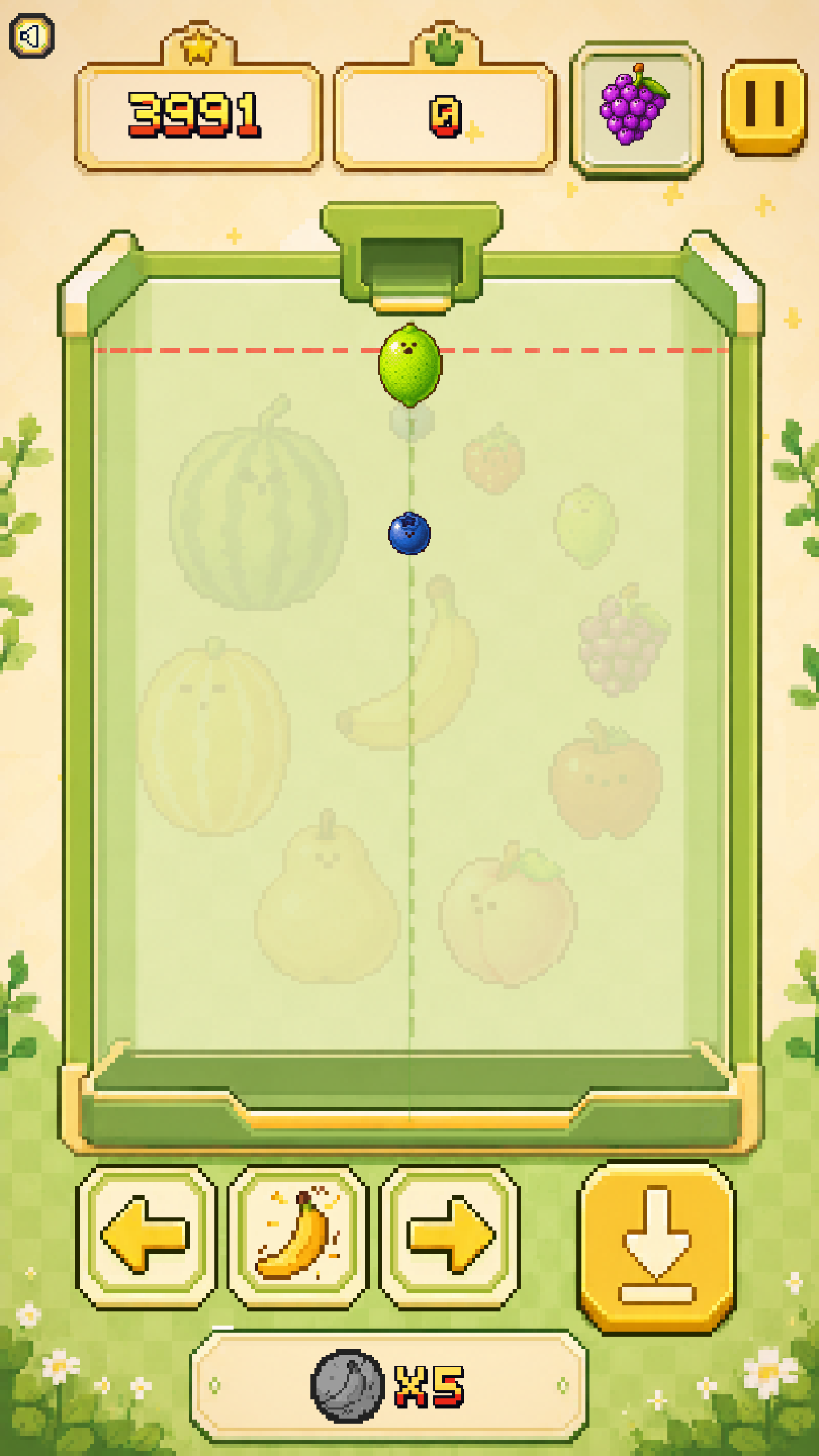
A run begins with five shake tokens. Merges refill the token meter gradually; larger results contribute more, including 0.5 token for a watermelon result and 1 token for a banana. That makes shake a renewable resource, but not a free one.
- Shake to complete a near merge. Two matching fruit that are visibly separated by a tiny obstruction are the best target.
- Shake to reopen a landing route. A small lateral change can be enough when one round fruit is balancing on two others.
- Do not shake a loose board. When several large fruit are already moving, another impulse can replace one problem with three unpredictable ones.
- Keep one emergency token. The red-line warning is the moment when a controlled shake has the highest survival value.
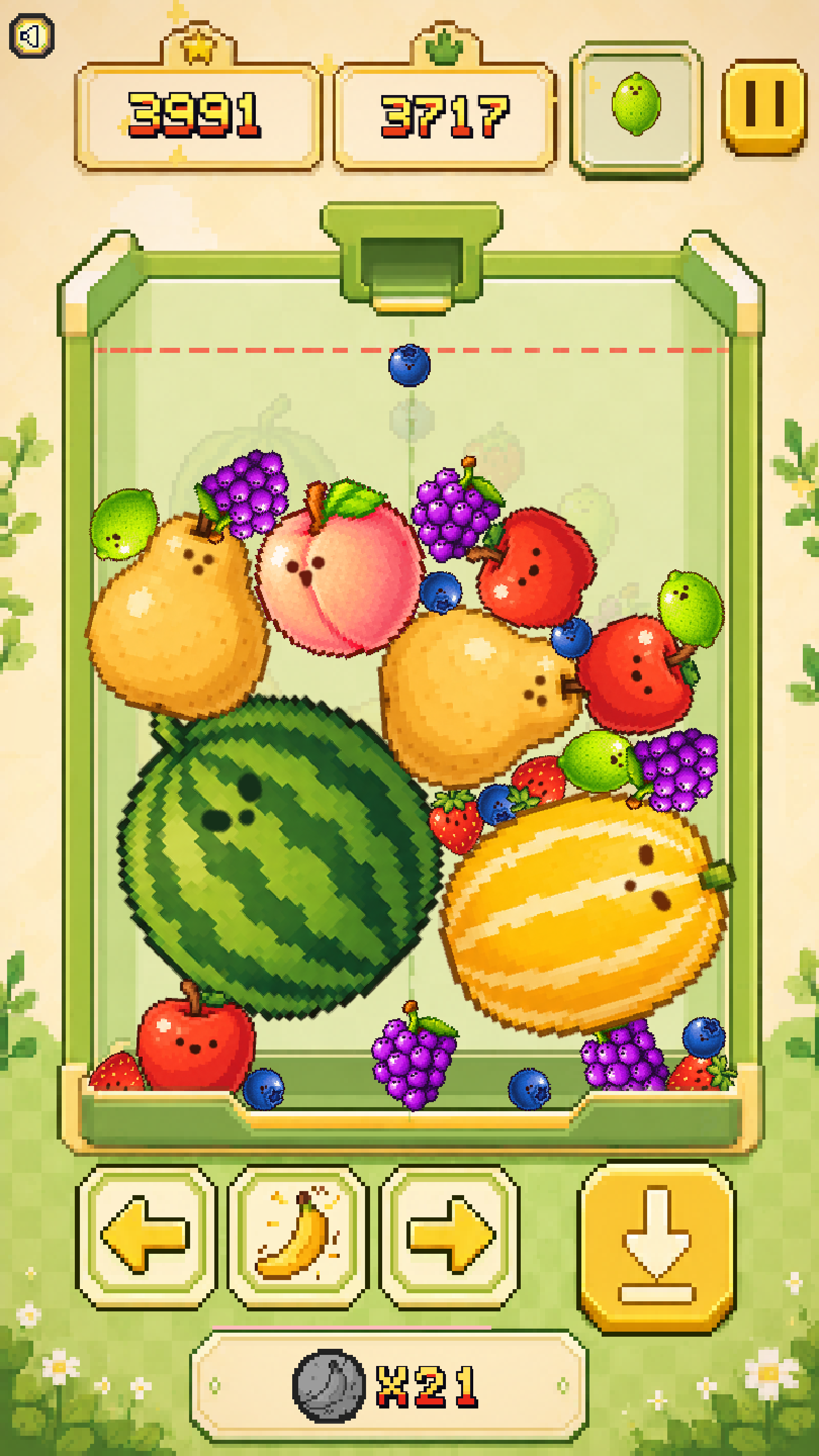
Read this 3,717-point board before choosing a drop
The gameplay image below is a recorded position, not a promise of the next result. The current piece is a blueberry and the preview is a kiwi. A watermelon fills the lower left, a Korean melon fills the lower right, and pears, a peach, apples, and grapes form the upper surface.
- Find an exposed match. A blueberry sits just right of the large peach, above the central pear. Aiming toward that pocket is a candidate move, but the grape bunch above it may intercept the falling fruit. Check the visible route, not just whether a matching fruit exists.
- Ignore the tempting buried matches. Several blueberries lie at floor level. The two largest fruit block their direct landing routes. Dropping above a buried match will not make the new fruit pass through the stack.
- Plan for the preview. There are kiwis near both outer edges. Keep at least one of those routes usable for the next piece instead of building a new tower above both sides.
- Use the 21 tokens deliberately. There are two pears and several apple-sized obstacles, but the large fruit support most of the board. A shake could create a useful contact or raise a new obstruction. Watch one shake settle before spending another.
For practice, name the match you expect before each drop, then compare the landing with that prediction. If it misses, look for the first surface that deflected it. This makes the next decision more useful than repeatedly aiming at the same buried fruit.
Recovering at the red deadline
The warning begins when fruit remain over the red line, so the fastest useful action is usually below the line: finish a merge that removes support and lets the top piece fall. Dropping another fruit directly onto the highest point often adds weight without changing the structure.
First look for a matching pair already close together. Next, check whether the waiting fruit can complete a pair near either wall. Use shake only when it has a likely target. If none of those choices exists, place the smallest available fruit into the deepest open route rather than balancing it on the top edge.
A successful recovery may leave the board untidy. That is acceptable. The immediate goal is to move every fruit below the line; rebuilding clean lanes comes after the warning has ended.
A simple decision order for every drop
- Can the waiting fruit merge immediately without closing the main route?
- Can it join a connected strawberry or apple recipe that is already underway?
- Can it rest beside its next likely partner instead of on top of a larger fruit?
- Will the landing create a flat bridge that hides unmatched fruit underneath?
- If the pile is near the deadline, which placement lowers the highest supported piece?
This order is intentionally practical rather than perfect. Physics can change the final resting place, but making each drop answer one of these questions produces a board with more recoverable options.