 Banana Game
Preserve a landing lane
A low, open route near the center lets new blueberries and strawberries reach useful partners. Building isolated towers may score quickly, but it also strands small fruit at the top.
Official site by Mainu Studio
Drop fruit, merge matching pairs, build unusual banana recipes, and keep the pile below the red deadline.
The game in one minute
Each turn begins with one of four small fruit waiting above the board. You choose its horizontal position, drop it, and watch gravity decide how it settles against the existing pile. When identical fruit touch, they merge into the next fruit in the chain. That sounds predictable until round fruit roll away, large fruit block a useful route, or a curved banana holds another piece above the board.
The immediate goal is to make room for the next drop. The longer goal is to build valuable fruit and special banana recipes without leaving anything over the red line. A fruit that remains above that line starts a three-second warning. During that warning, one merge, roll, or carefully timed shake can still rescue the run.
What makes it different
The normal merge chain runs from blueberry through strawberry, kiwi, grape, apple, peach, pear, Korean melon, watermelon, and finally banana. Banana Game adds connected-group recipes on top of that familiar pair rule. Six touching strawberries or four touching apples can create a banana directly. Three bananas create a Golden Banana, and two Golden Bananas clear each other for a large score reward.
Those recipes change how a crowded board is read, but they do not turn off automatic pair merges. A recipe needs its full connected group to be present when the game checks contacts; two strawberries touching earlier will already become a kiwi. Treat a large group as an opportunity during a chain reaction, not as six ingredients you can slowly park together. A curved banana can then become either a valuable ingredient or a physical obstacle.
Open the recipe and score tables or read the board strategy guide for practical examples.
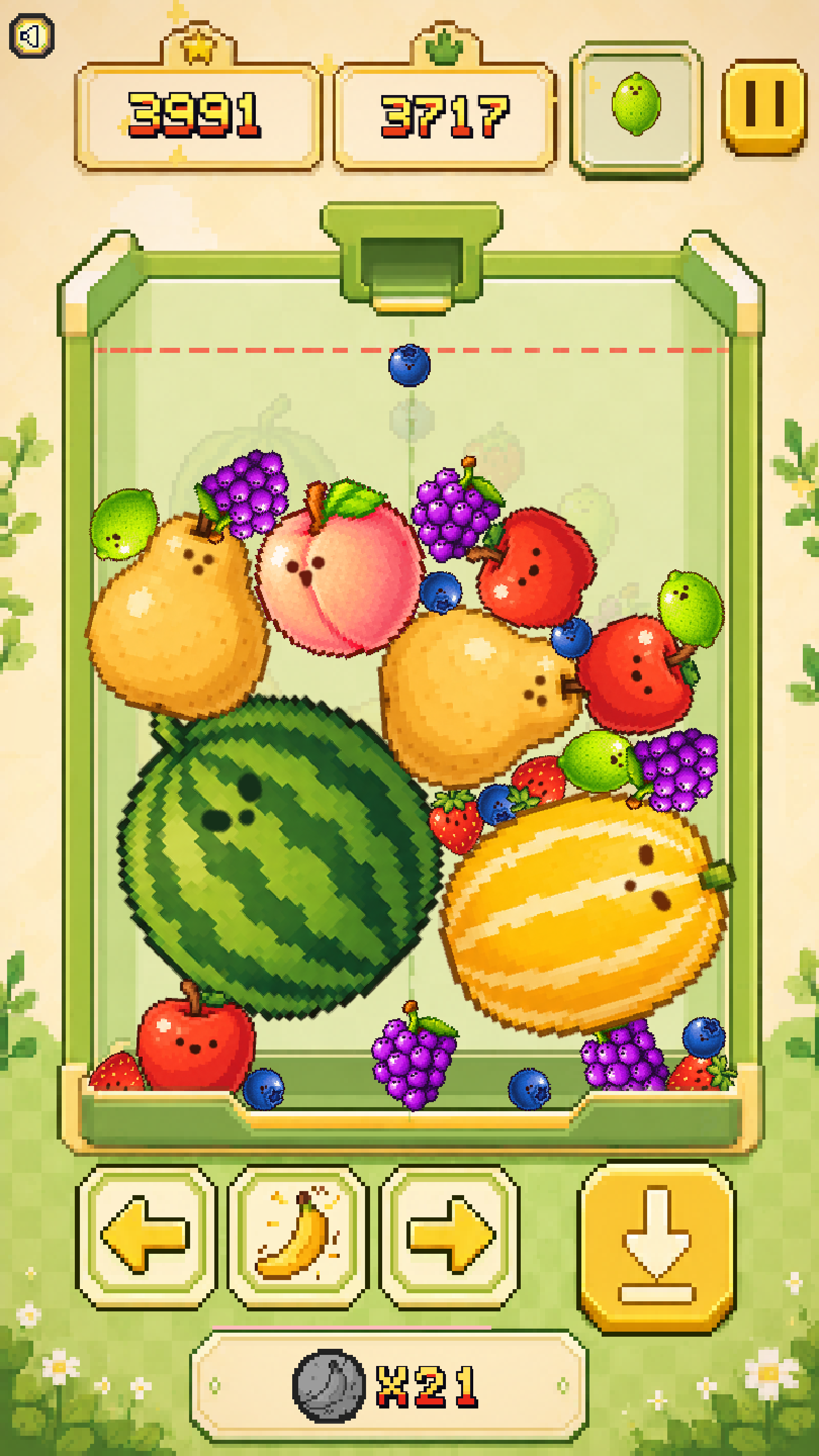
A low, open route near the center lets new blueberries and strawberries reach useful partners. Building isolated towers may score quickly, but it also strands small fruit at the top.
The preview turns a random sequence into a planning problem. A safe drop for the current piece can be a bad choice if it blocks the next piece from its only match.
A shake is most effective when two matching fruit are already close or a banana is wedged beneath a heavier piece. Shaking a sparse board usually spends a token without creating a useful collision.
The red line is not an instant loss. The warning window is a final tactical phase: drop into an immediate merge, use a saved shake, or free a fruit that can roll back into the board.
Controls and accessibility
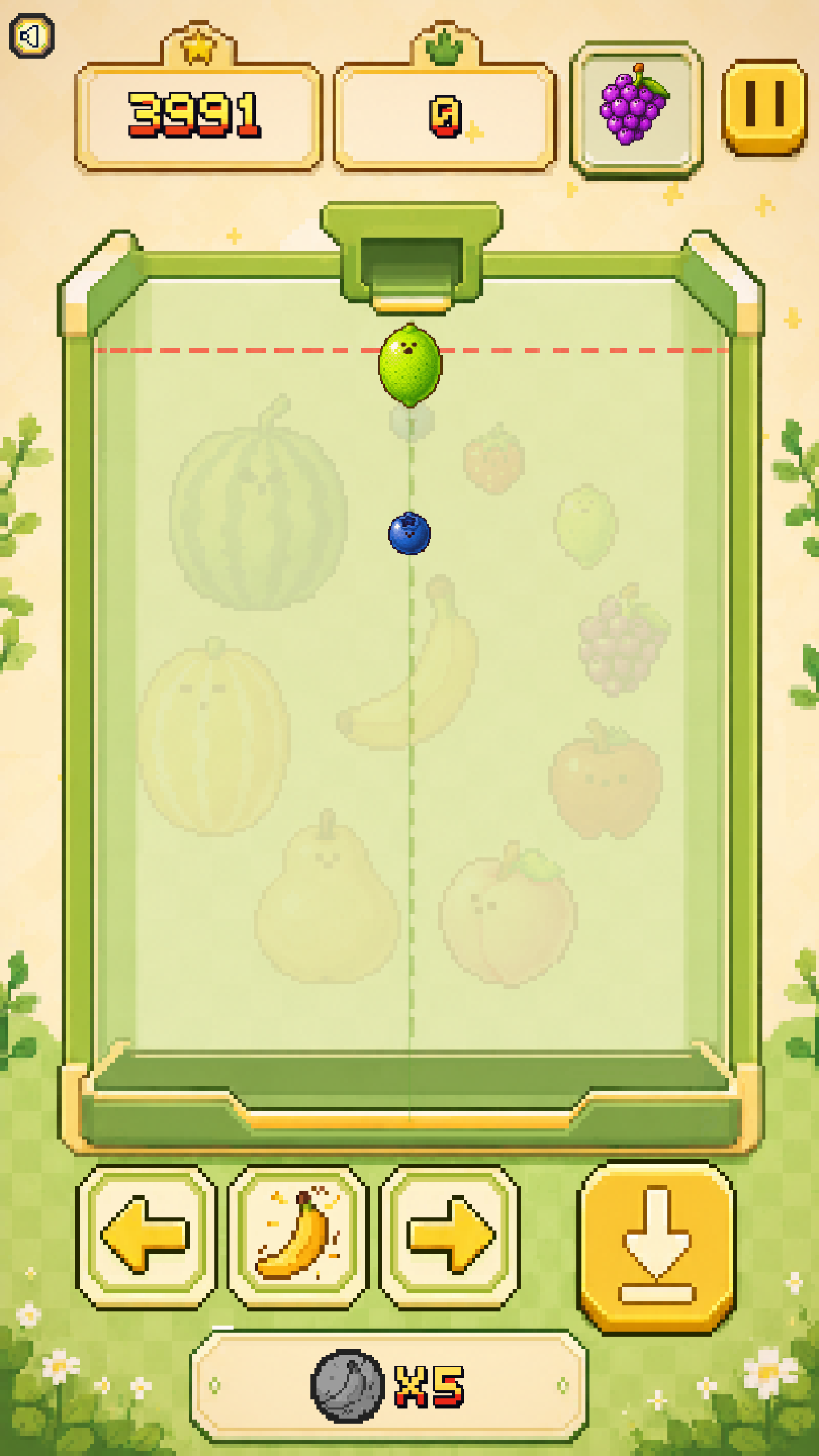
On touch screens, the large on-screen controls move the aim, trigger a shake, and hold fast drop. Desktop players can use the arrow keys or A and D to aim, Enter or W to drop, Space or M to shake, and Escape or P to pause. Gamepad mappings cover the same gameplay actions and menu navigation.
The interface uses fixed portrait artwork with responsive scaling so the board remains readable on phones and desktop windows. Sound, music, graphics quality, language, and fullscreen controls can be changed without starting a new run.
The browser edition is v1.0.2; store builds have their own update schedules. The web edition can read the public leaderboard but does not submit browser scores. This prevents an unsigned browser session from writing to the native leaderboard.
This site documents the current game rather than repeating a store description. The player guide records exact recipes, score values, controls, and token rules. The strategy article explains how real board geometry changes a run. The development journal covers the technical problem of making a curved banana roll and stack without destabilizing every other fruit.
Banana Game is an independent Godot project by Mainu Studio. The project focuses on a compact play loop, readable pixel-art interfaces, predictable fruit physics, and consistent controls across browser, Android, and Windows builds. Gameplay documentation and policy pages are maintained alongside the game so players can understand both the rules and how browser data is handled.
Bug reports, accessibility feedback, and site questions can be sent to [email protected]. For data handling and site terms, see the Privacy Policy and Terms of Use.